
Brand partnerships, card-linked offers, alternative payment models and the threat of AI provided a whistle-stop tour of the current affiliate market at last week’s Performance Marketing World Unlocked event in London.
Affiliate and Partner Marketing Association Director, Kevin Edwards, was joined on stage by Awin’s Client Services Director, Dawn Quigg, to discuss some of the key growth areas unearthed from last year’s Voice of the Affiliate Nation survey.
A £1.7bn growth channel
First up, Kevin shared some of the highlights from the 2025 State of the Affiliate Nation report that scales the UK market.
Posting £1.7bn in affiliate spend, the channel grew by 9% year on year, emerging as one of the fastest-growing digital disciplines. He also shared how the industry drives one in ten ecommerce £s spent by UK consumers.
Having set the scene, he turned to the qualitative Voice of the Affiliate Nation, which last summer surveyed close to 300 UK-based affiliate marketers, the submissions drawn from major publishers, brands and agencies.
Understanding how brands feel about the affiliate channel is a key concern for the APMA. This led to one of the questions asking how strategically embedded affiliate marketing is in their overall businesses. While that term can mean different things to different people, the score would help create a benchmark to judge the success of future APMA projects.
At 6.5 out of ten, Kevin stated that it’s a score that is difficult to pin down. Some might view it as simply average, while others may view it as a positive. With the caveat that the survey was self-selecting (so potentially skews higher), given the broad range of brands that responded by size and sector, it at least suggests that affiliate marketing is widely used, even if it is not always treated as a strategic channel.
“That number is actually useful for us,” he said. “If the starting point is 6.5, the challenge is how the industry moves that closer to seven or eight. Greater trust in the channel usually leads to greater investment, and that’s the basis for some of the output from this year’s APMA roadmap.”
Publishers continue to invest
Kevin then shared additional data from the survey, which also showed strong optimism among publishers.
Thirty per cent reported increasing headcount during the past year, with only a small proportion reducing staff numbers. Growth for publishers usually leads to reinvestment in new tools and technologies as well as the teams to build them.
The symbiotic relationship between publisher growth and brand investment was also displayed in the report data. 45% of brands surveyed reported they expect to increase their affiliate budgets in 2026, with a similar number saying they expect the budgets to remain stable. Fewer than 10% plan to cut affiliate expenditure.
Discussion: where brands are investing next
After presenting the research findings, Kevin invited Dawn onto the stage to discuss the areas where brands are interested in focusing their time and investment over the next 12 to 18 months, based on another of the survey questions.
Brands could select up to three options from a prescribed list, or add their own suggestions. Taking the data and aggregating by themes showed a clear intent which formed the basis of the discussion.
They focused on three broad areas that covered the majority of the areas mentioned:
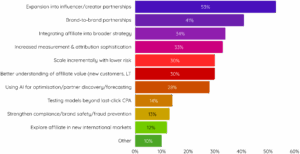
First up, they discussed influencers, brand-to-brand, and creator partnerships. Dawn said brands are increasingly integrating creators into affiliate programmes.
“We have already seen a 39% increase in investment into influencer activity in the past year,” she said, explaining that the approach brands are taking has evolved in recent years.
“In the past, brands often focused on the largest creators with the biggest audiences. What we are seeing now is a shift towards micro and nano influencers.”
According to Dawn, these smaller creators often produce better results: “they tend to have stronger engagement with their audiences, and they feel more authentic. For many brands, that leads to better conversion.”
She also noted that brands are increasingly integrating influencer activity directly into performance marketing campaigns: “affiliate technology now allows brands to track creator activity properly and reward it on a performance basis,” she said.
Brand partnerships are expanding
Another high growth area, mirrored in the survey by interest, is brand-to-brand partnerships.
This model allows brands to participate and act as publishers, working with non-competing brands that offer complementary products to each other’s customers.
Dawn said this model is one of Awin’s fastest-growing, with a team dedicated to expanding a brand’s affiliate programme into this relatively new area. She gave the example of travel companies partnering with airport parking providers or related travel services.
“If a customer is booking a holiday, it makes sense to show them relevant offers from related services.”
These partnerships often are at the point of checkout or even post-checkout.
“Some brands offer a gift or incentive from a partner brand at the point of purchase,” Dawn explained. “That can increase conversion rates at the final stage of the customer journey.”
She summarised the current status at Awin by quoting that more than 5,000 brand partnerships are currently active across the company’s network, generating more than £100 million in revenue. Kevin added that they had changed the conversation in affiliate marketing from one focused on acquisition to retention. This shift changes how the channel is discussed and also measured.
Attribution remains a challenge
The discussion then switched from partnership development areas to measurement and attribution. Kevin quoted State of the Nation data that shows around one in eight pounds tracked through the affiliate channel is spent on what he labelled ‘non-last click CPA’ activity.
He asked whether that was because many brands are interested in moving beyond last click attribution to reward earlier funnel activity.
Quigg said that while many brands analyse attribution data and are interested in rewarding introducers who don’t necessarily close sales, brands do not always implement more complex models operationally.
“Brands want to understand the full customer journey,” she said. “But in reality, many still rely on relatively simple attribution models.”
She added that improving measurement remains an important area of development for the industry, “as investment grows, brands want greater confidence in how performance is measured.” Attribution in the affiliate channel remains elusive, despite years of seemingly circular conversations on the subject. The APMA is planning on focusing on at least one major attribution project in 2026.
AI brings both risks and opportunities
Finally, Kevin turned to AI and referred to findings from the surveys that show that while publishers generally are not negative about the opportunities, there is a great deal of uncertainty about how much of a growth area it currently is.
Dawn said AI is probably the area she hears most about when chatting to brands: “this is probably the question we are asked most often at the moment,” she said.
“One of the risks is the growth of zero-click environments where users receive answers directly from search engines or AI systems. That can reduce visibility for publishers.”
However, she also highlighted the potential benefits of AI. “AI can support partner discovery, forecasting and campaign optimisation,” she said. “It allows platforms to analyse performance data and make recommendations much faster.”
The APMA formed an AI taskforce last month, and the initial roadmap has been created. Watch out for future updates on this business-critical topic.
Card linked offers are emerging as a major opportunity
Kevin rounded off the session by asking Dawn to name one further area that she believes will grow significantly over the coming year. She opted for card-linked offers.
These affiliates connect promotions directly to consumer payment cards, allowing offers to be activated and rewarded automatically when a purchase is made.
Dawn said the model is still relatively early in its development, but is already attracting strong interest from brands. The instant and highly integrated nature of the activity is hugely appealing to brands, and that is reflected in the businesses investing in the models. “There is a huge amount of volume coming through this space,” she said. “It is still developing, but more brands are starting to test it.”
Card-linked offers allow advertisers to connect with large consumer audiences through banks, fintech apps and loyalty programmes.
Consumers simply register their payment card with a platform. When they purchase at a participating retailer, the reward is applied automatically.
Dawn added that this model creates a number of advantages for advertisers, “you are reaching audiences through financial platforms that people use every day,” she explained. “That creates a very strong level of engagement.”
“Card-linked offers also make it possible to track and reward transactions that happen in physical stores as well as online,” she said.
This capability is attracting attention from large retailers and travel brands that want a clearer view of total customer spending. Dawn closed by saying that new publishers were developing specialist platforms backed by strong momentum in this area.
A consumer empowerment model
Kevin closed by citing some of the key talking points from a presentation he gave to the Information Commissioner’s Office late last year.
Wanting to give a one-slide snapshot of the power of the channel, he referenced it as the original consumer empowerment channel, connecting consumers to deals, discounts and better buying decisions.
He also drew attention to how the channel can do this while remaining a data-light and privacy-conscious offering that attracts some of the most innovative business ideas and startups in the UK.
Want to read the full Voice of the Nation report? Download it in full, for free here.